
Stalled Disinflation, AI Productivity, and Geopolitical Shocks: The New Global Growth Reality for Mid-2026
-
Stalled Disinflation, AI Productivity, and Geopolitical Shocks: The New Global Growth Reality for Mid-2026

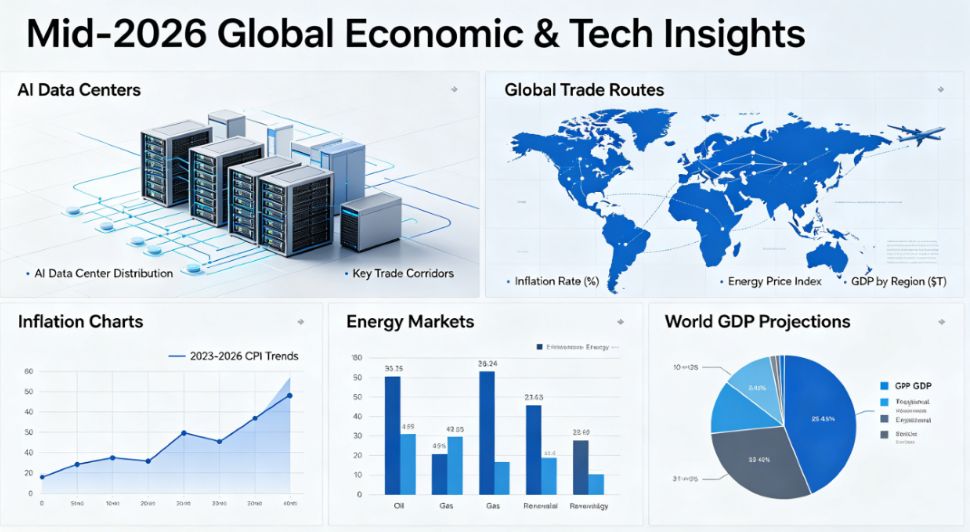
The International Monetary Fund (IMF) projects global economic growth of 3.0 percent in 2026, followed by a recovery to 3.4 percent in 2027, reflecting an economy that has proven more resilient than expected despite conflict, higher energy prices, and ongoing trade uncertainty. The latest July 2026 World Economic Outlook update shows that technology investment, particularly in artificial intelligence, has helped offset some of the drag from geopolitical shocks, although the recovery remains uneven across regions.
Learn how cooling price declines, rapid AI adoption, and shifting trade blocs are rewriting global economic forecasts and risks. That message sits at the center of the IMF’s latest assessment. Research shows countries with strong positions in AI hardware, cloud infrastructure, and advanced manufacturing have generally exceeded expectations, while energy-importing economies with limited participation in the technology value chain continue to face greater pressure.
Why Inflation Is Proving Stickier Than Expected
The biggest change since the IMF’s previous forecast is the pause in global disinflation. Headline inflation is now expected to average 4.7 percent during 2026, revised upward because of higher oil prices, elevated shipping costs, and continued geopolitical tensions. While inflation has fallen significantly from post-pandemic peaks, the latest data indicates that progress has slowed, leaving many central banks cautious about cutting interest rates too quickly.
Experts note that the recent conflict in the Middle East has increased uncertainty surrounding energy markets and global supply chains. Although emergency inventories, expanded production outside the Gulf, and growing renewable energy capacity have softened the impact, businesses continue to face higher transportation and operating costs than earlier forecasts anticipated.
How AI Is Supporting Productivity Growth
Artificial intelligence has emerged as one of the strongest counterbalances to these economic headwinds. Findings from the IMF highlight that investment in AI infrastructure, semiconductor manufacturing, cloud computing, and automation has accelerated capital spending across several economies. This investment cycle is improving productivity, supporting exports, and encouraging business expansion despite higher financing and energy costs.
Countries including South Korea, Taiwan, Malaysia, and Thailand have benefited from strong demand for AI hardware and related technologies. Reports from the IMF suggest these economies have received meaningful growth upgrades because technology exports have remained exceptionally strong. At the same time, policymakers remain aware that overly optimistic expectations surrounding AI valuations could create financial market volatility if projected returns fail to materialize.
Trade Fragmentation and Regional Growth Gaps
The global outlook is becoming increasingly fragmented. Energy exporters outside conflict zones have generally gained from stronger commodity prices, while many advanced technology economies continue to benefit from rising investment. Meanwhile, lower-income countries and energy-importing economies with limited technology exposure face slower growth and greater inflationary pressure. Trade diversification is helping reduce dependence on individual shipping routes, yet geopolitical risks continue to influence logistics, manufacturing, and investment decisions.
Businesses are responding by expanding regional supply chains, increasing inventory flexibility, and investing in digital technologies that improve efficiency. These adjustments strengthen resilience, although they cannot fully eliminate exposure to geopolitical disruptions or commodity price swings.
Critical Indicators to Monitor Through Q4 2026
Several indicators will shape the global economy during the remainder of 2026. Inflation trends, central bank policy decisions, energy prices, AI investment momentum, shipping conditions through key trade corridors, and global trade policies all deserve close attention. A faster normalization of energy markets could improve confidence, while renewed geopolitical escalation could quickly reverse recent gains.
The latest forecasts present a picture of cautious resilience. Economic growth continues despite significant challenges because technology investment is supporting productivity and business activity. Whether that momentum continues will depend on how successfully governments, businesses, and financial markets manage inflation risks while adapting to an increasingly technology-driven global economy.

 Feed
Feed

- Stalled Disinflation, AI Productivity, and Geopolitical Shocks: The New Global Growth Reality for Mid-2026The International Monetary Fund (IMF) projects global economic growth of 3.0 percent in 2026, followed by a recovery to 3.4 percent in 2027, reflecting an economy that has proven more resilient than expected despite conflict, higher energy prices, and ongoing trade uncertainty. The latest July 2026 World Economic Outlook update shows that technology investment, particularly.
- Economists Urge Businesses to Explore the Database as Supply Chains Reveal Hidden Industrial PowerA quiet refinement of focus has been happening among economists, though it rarely makes the headlines. Instead of watching stock market fluctuations or waiting for government indicators, some economists are beginning to examine something more structural: the relationships between firms. Once analysts explore the database of supply chains, a different picture of industrial power begins.